
Searching Camp County Civil Dockets
Start with the type of dispute. For district civil and family files, the Camp County District Clerk is the first call. Probate and guardianship matters in the constitutional County Court run through the County Clerk instead. Justice Court handles its own limited civil work. Its caseload includes small claims, debt, and landlord-tenant cases under current law. That court posts no public civil docket portal.
re:SearchTX may hold eligible integrated civil records. Registration is required, and Camp coverage varies case by case. A thorough search uses every channel available:
- Identify the court and likely clerk from the case type.
- Search re:SearchTX by case, filing, text, or hearing where eligible.
- Call or email the proper Camp clerk if the result is absent or incomplete.
- Visit the District Clerk, County Clerk, or JP counter when needed.
- Ask whether inspection, a plain copy, or certification best fits the need.
Which Camp County Civil Clerk?
Both clerks work out of the courthouse at 126 Church Street in Pittsburg. Their records do not overlap. District Clerk Kelly Gunn sits in Room 204 and lists 903-856-3221 and kelly.gunn@co.camp.tx.us. County Clerk Sandra Knight sits in Room 102. She lists 903-856-2731 and sandra.knight@co.camp.tx.us. Each office posts weekday hours with a noon closure and an earlier Friday close.
| Case route | First contact | Typical need |
|---|---|---|
| District civil or family | District Clerk | Docket, pleading, order, judgment |
| Probate or guardianship | County Clerk | Public index or allowed record |
| Small claim, debt, or eviction | Justice Court civil clerk | Cause status, setting, filed paper |
If a clerk refers you elsewhere, write down the court and clerk name before you move on. A city, courthouse, or county name alone does not establish which office holds the file.
Inside a Camp County Civil Docket
A civil docket can show the caption, parties, filing date, status, attorneys, filed documents, motions, settings, court actions, and final disposition. Not every filing comes with a viewable image. Civil case detail in Camp County generally requires registration or a request to the clerk, so copy labels and the cause-number style straight from the record.
| Cause number | The court's exact identifier, such as court-issued cause number. |
|---|---|
| Case style | The caption naming the parties in their procedural roles. |
| Filing event | A petition, answer, motion, exhibit, or other indexed item. |
| Setting | A docket call, non-jury hearing, pretrial, jury trial, or special setting. |
| Disposition | A signed order, judgment, dismissal, or other event that closes or changes the case. |
Camp County Civil Docket Filings
OCA's FY2024 district detail offers a workload snapshot for Camp County. The civil side reported 363 cases active at the start. It added 87, disposed 65, and closed with 375 active. Family cases ran from 156 active at the start. They added 155, disposed 104, and ended at 171 active. Juvenile numbers were smaller: 15 beginning, 9 added, 14 disposed, and 4 ending.
These are report figures, not individual outcomes. One active case can carry many docket events. A disposed count tells you nothing about which party prevailed or what relief the court ordered.
Civil Case Types on the Docket
Camp civil records split by jurisdiction and subject matter. Major civil matters, family cases, juvenile work, and other assigned jurisdiction belong to the district courts. The OCA directory lists the regional 276th court with civil, family, juvenile, probate, criminal, and child-protection caseload types, though actual Camp assignments can turn on court orders. County and justice routes stay separate.
- Contract, debt, tort, and property disputes in the proper court
- Family and child-protection matters, with access limits where required
- Probate and guardianship matters through the county route
- Small-claims and other limited civil matters in Justice Court
- Appeals and post-judgment events within the correct statutory path
Guardianship files can hold sensitive medical and financial material. Ask for a public index, docket, or redacted copy rather than assuming the whole file is open.
Camp County Civil Search Tabs
The official re:SearchTX portal works through a registered-user workflow. It offers Cases, Filings, Text, and Hearings modes. Cases locates case descriptions. Filings targets submitted items. Text can search eligible indexed material, while Hearings focuses on scheduled events. Filters narrow results by county, court, date, type, and other fields your role permits.
A hit on one tab promises nothing on another. A case description can exist with no downloadable pleading behind it. A hearing can appear while the signed order sits only with the clerk. The integration program offers no guarantee. Not every Camp County civil docket is current, complete, or free. Note the date you searched and what kind of item you found.
Camp Civil Docket Settings and Hearings
Published district schedules for Camp use certain labels. They include civil docket call, civil non-jury, civil pretrial, civil jury trial, and special settings. A schedule PDF is a planning document. It does not list all parties. It does not prove a hearing occurred or replace the live case docket. After a reset or continuance, call the clerk or coordinator to verify the date.
Docket call reviews the status and scheduling of several cases at once. A non-jury setting puts the matter before the judge alone. Pretrial covers issues that come before trial, and a jury-trial setting reserves trial time. A special setting may fall outside the ordinary calendar pattern. The Camp County court dates page gives the fuller calendar route. But the civil case record remains the source for what actually happened.
Copies Beyond a Camp County Civil Docket
A search result, a docket, a pleading, and a certified judgment are different products. The public case index may name the cause and parties yet omit the petition. The docket may list an order without its image. A transcript comes from a court reporter, not the clerk's event list. Describe the product you need precisely to avoid delay.
| Product | What it provides | Where to ask |
|---|---|---|
| Inspection | Review of a public record without certification | Record custodian |
| Plain or electronic copy | Reproduction without official certification | Clerk holding the file |
| Certified copy | Clerk-certified reproduction for an official purpose | District, County, or JP clerk |
| Transcript | Prepared record of reported proceedings | Court reporter |
Camp County publishes no local copy fee sheet or firm turnaround. Ask the clerk for a quote covering pages, certification, postage, conversion, and any lawful research charge.
Civil Docket Access Rules
Judicial records in Texas take a different route than records held by executive agencies. Government Code section 552.0035 hands the question over to Supreme Court rules or other law. Rule 12 builds the basic framework for judicial records. Civil cases have their own sealing rule. Texas Rule of Civil Procedure 76a governs when a court record can be sealed. Some civil dockets carry extra limits too. Family, juvenile, guardianship, and protected personal data may be restricted beyond the usual rules.
Ask for the public form of the record. If an attachment cannot be released, ask whether the clerk can provide a redacted copy, the public docket entry, or the order that controls access.
Just because an item does not show up in a civil docket search does not mean it does not exist. It may simply be unavailable in that search. The custodian might have to review the filing, redact details, pass the request to the judge, or point to a rule that blocks release.
Camp County Civil E-Filing Is Not Search
Most civil, family, probate, and criminal filings in Texas now move through eFileTexas. That is the statewide filing channel. A filer signs up with an electronic filing service provider. The filer types in the case details, uploads the papers, and pays the charges. The clerk then accepts the filing or sends it back. The Camp District Clerk is blunt on one point. E-filed filings are not refundable under any circumstances.
Sending papers is not the same as public access, though. That workflow delivers documents to a court. But it does not promise that anyone can search or download the resulting docket. The Texas Historical Commission source records the courthouse's 1928 history.
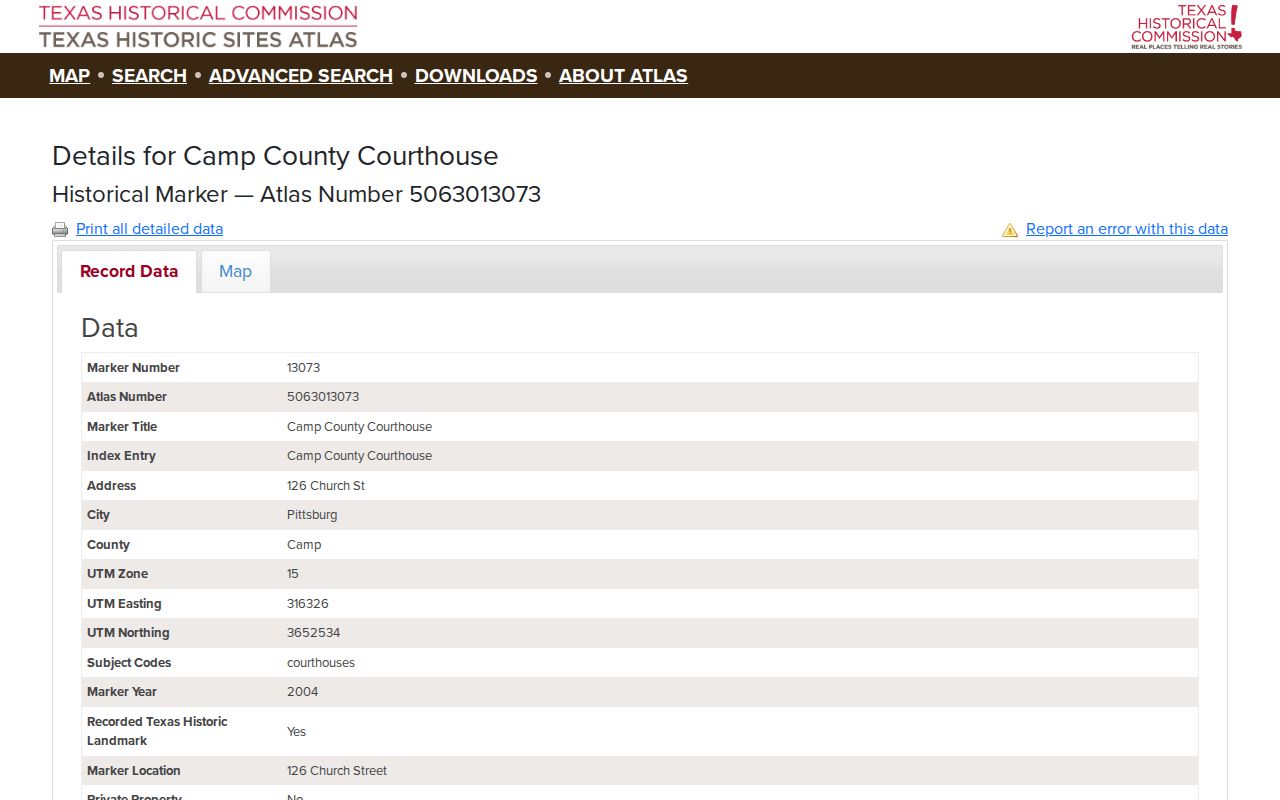
The marker connects today's civil clerk counters to a public building that has safeguarded county government records for generations. A second UNT archival source shows the Camp County courthouse in 1975.
That archival image is a reminder of the long custody chain behind the current mix of service. Counter help, scanned schedules, e-filing, and repository searches all rest on generations of record keeping.